After the Lightning: Luxembourg Begins Organizing for Survival
Luxembourg is beginning to talk about AI readiness, but survival depends on enterprise AI adoption, operational adaptation, and visible execution.
Something changed recently.
Not publicly. Not dramatically. Not enough to reverse the trajectory.
But for the first time in a long while, I sat in a room where at least some people no longer spoke about AI as if it were a futuristic innovation topic reserved for keynote speakers and strategy slides.
The mood has changed.
Not because optimism suddenly appeared, but because reality finally entered the room.
The irony is that many still describe what is happening as "preparing for AI."
But that framing is already outdated.
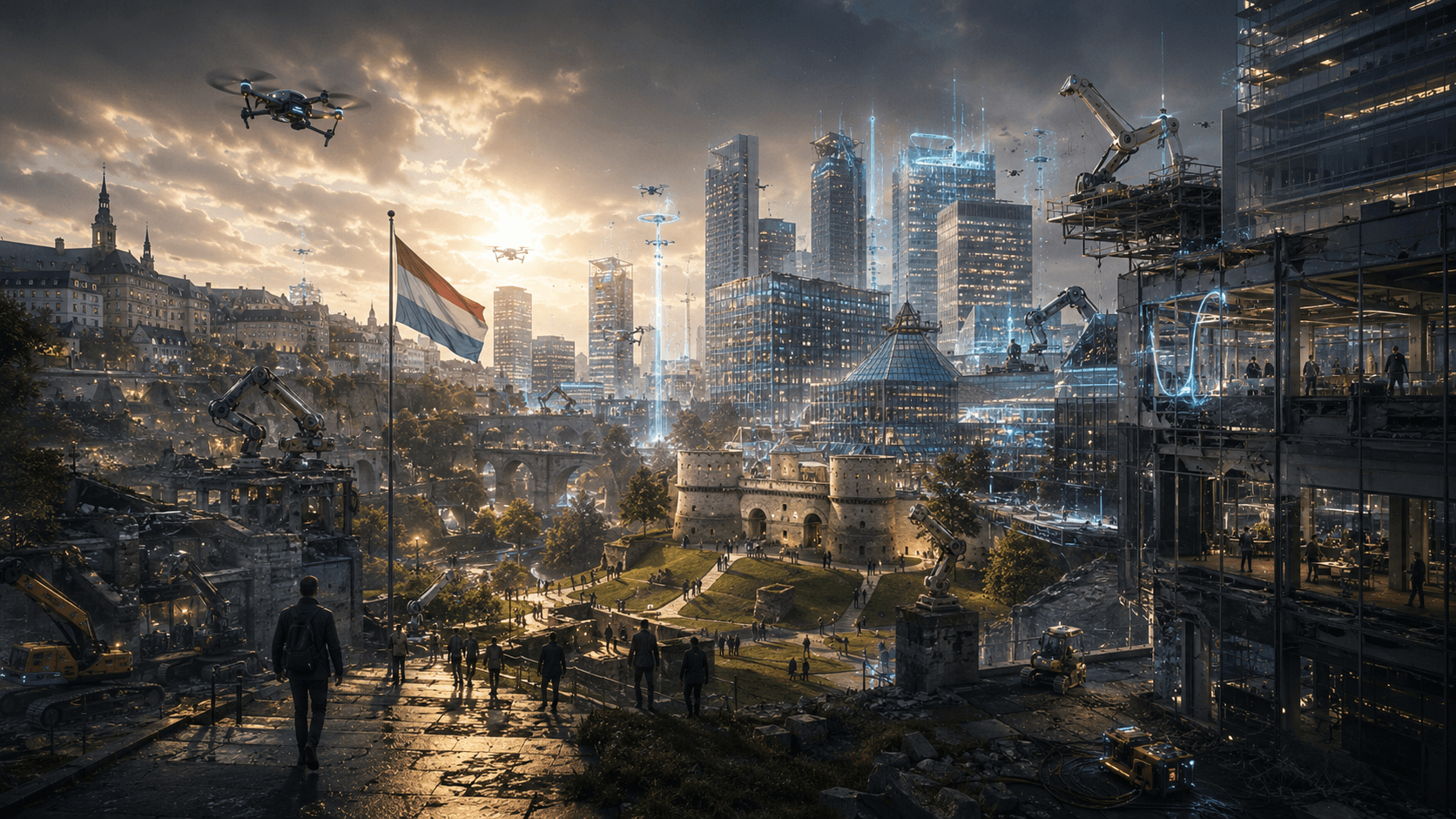
The tsunami already hit.
We are not preparing for impact anymore. We are discussing how to survive the flooding.
From AI Discussion To AI Survival
For years, Luxembourg treated AI like most institutional topics:
- create working groups
- launch initiatives
- organize conferences
- publish roadmaps
- build ecosystems
- announce strategic ambitions
To be fair, some of these efforts are sincere. The people behind initiatives such as Fit 4 AI, Luxinnovation, the AI Factory, and parts of the broader innovation ecosystem are not blind.
Many clearly understand that Luxembourg cannot continue operating on inertia alone.
The problem is not lack of intelligence.
The problem is the speed of the storm versus the speed of institutional adaptation.
The Economics Are Already Changing
Outside the conference rooms, the economics are already shifting.
AI agents are replacing workflows. Automation is replacing layers of administration. Smaller teams are achieving outputs that once required entire departments.
Consulting is changing. Software development is changing. Marketing is changing. Compliance is changing. Financial analysis is changing.
Slowly, almost invisibly, the assumptions underneath Luxembourg's economic model are beginning to erode.
This is why the symbolism of these meetings matters more than the meetings themselves.
When Luxembourg gathers consulting firms around AI readiness, maturity assessments, roadmaps, and transformation programs, what we are really witnessing is something deeper:
Parts of the system have started realizing that survival now depends on adaptation speed.
That realization alone is already a major shift.
That is the practical layer behind Make It Happen: AI readiness consultancy for enterprises that have to move from awareness to working systems. Its AI Visibility Studio exists for the same reason on the market side, because companies that cannot be understood by AI search and answer engines will become harder to find exactly when procurement behavior changes.
AI Breaks Luxembourg's Old Assumptions
For decades, Luxembourg operated inside a protected equilibrium:
- stability
- predictability
- gradualism
- consensus
- redistribution
- administrative expansion
AI breaks almost every one of those assumptions simultaneously.
The old world rewarded size. The new world rewards speed.
The old world rewarded process. The new world rewards execution.
The old world rewarded information ownership. The new world rewards adaptability.
And perhaps most dangerously for Luxembourg: AI dramatically reduces the value of bureaucratic complexity.
That sentence alone should terrify half the country.
Enormous parts of Luxembourg's political and economic equilibrium depend on systems where complexity itself became a source of legitimacy, employment, and institutional importance.
AI does not respect that logic.
It compresses. It simplifies. It accelerates.
The Question Nobody Wants To Ask
When AI reaches full maturity inside financial services, administration, legal work, compliance, and consulting, the question will no longer be whether jobs disappear.
The question will become:
Which structures still justify their cost?
That is the conversation almost nobody dares to have openly yet.
Still, I left that conference with one unexpected feeling:
Not hope.
Movement.
Some people are finally trying. Some understand that the old formulas are exhausted. Some realize that another digital strategy PDF will not save Luxembourg from structural irrelevance.
Some are beginning to understand that survival now requires operational transformation, not communication.
The Risk Of Administrative AI
The danger remains enormous.
Luxembourg still risks treating AI as an administrative modernization challenge rather than what it truly is: a civilizational economic reset.
This is not another technology wave.
Not cloud computing. Not mobile apps. Not digital banking 2.0.
This is a restructuring of how value itself is created.
Countries that misunderstand that distinction may spend the next decade optimizing systems that no longer matter.
That is why this newsletter exists.
Not to celebrate collapse. Not to spread fear.
But to document the transition honestly.
Because somewhere between denial and panic, a small number of people are already trying to build the tools, companies, systems, and knowledge Luxembourg may need to survive what comes next.
Whether they succeed or fail may quietly determine whether the lights on Boulevard Kennedy stay on at all.
Follow The Luxembourg AI Brief
Send leads, corrections, source material, or questions for our coverage on AI in Luxembourg and Europe.
ContactRelated analysis
Why Luxembourg's AI-first and digital sovereignty agenda cannot solve structural fragility without enterprise AI readiness, energy realism, and tax-base resilience.
Why The Luxembourg AI Brief tracks AI disruption, enterprise AI readiness, economic fragility, and Luxembourg's need to adapt faster.
How AI may reshape SME and enterprise competition through positioning, AI visibility, digital employees, operational intelligence, and AI-readable trust signals.