
The Wrong Bet: Why Luxembourg's AI-First Strategy Will Not Solve Its Deepest Problems
Why Luxembourg's AI-first and digital sovereignty agenda cannot solve structural fragility without enterprise AI readiness, energy realism, and tax-base resilience.
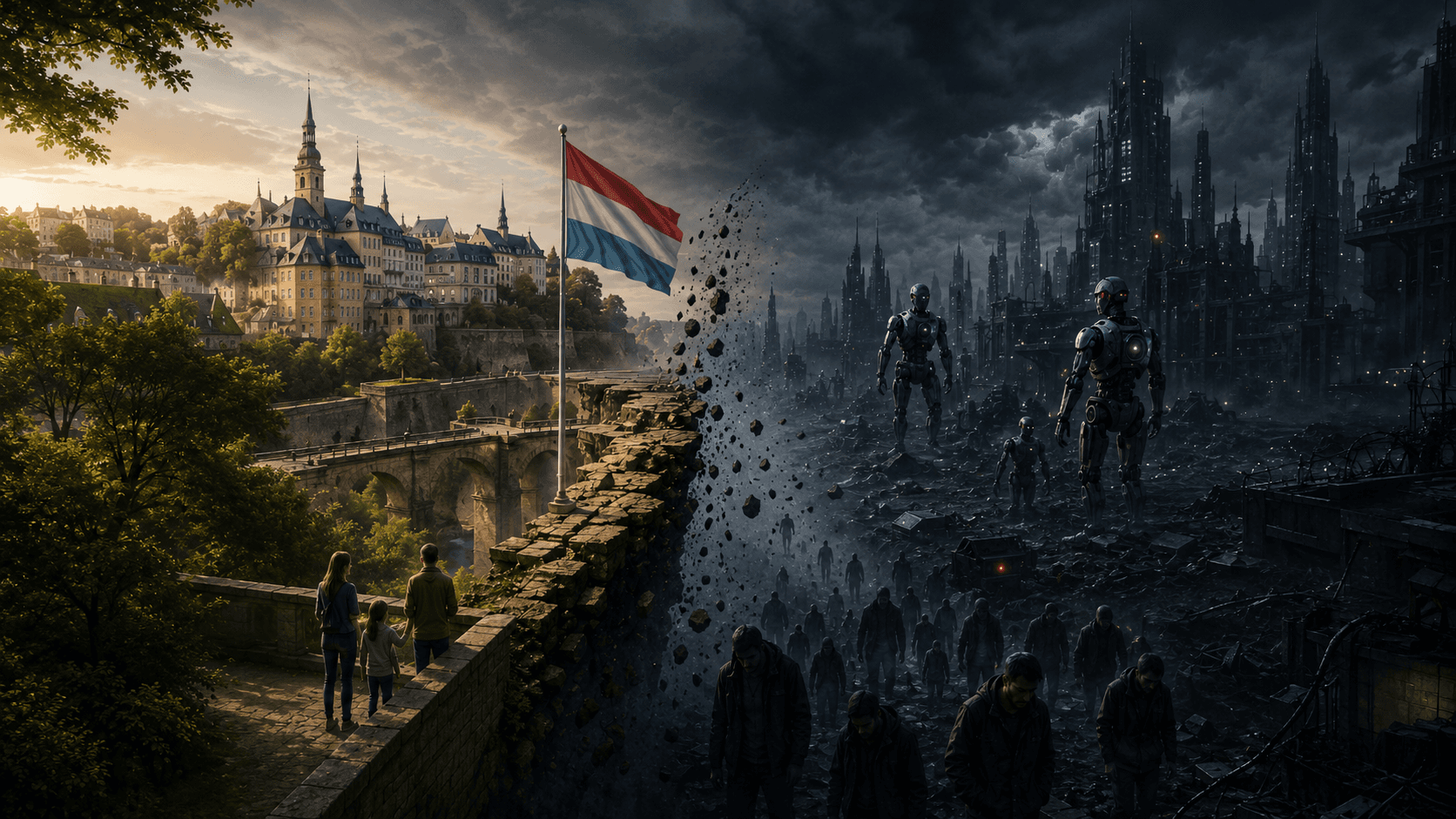
Luxembourg has a complicated relationship with honesty.
For a country that prides itself on precision in law, finance, and regulation, it has spent the better part of a decade telling itself a story that the data simply does not support.
The story goes like this: Luxembourg is small but smart, nimble but sophisticated, and if it embraces digital technology fast enough, it can sustain prosperity, decarbonize its economy, and remain globally competitive without fundamentally changing how it lives or what it consumes.
In May 2025, the government made this bet official. The launch of Accelerating Digital Sovereignty 2030, with national strategies for data, artificial intelligence, and quantum technologies, signalled where the current coalition stands.
AI, in this vision, is not just a productivity tool.
It is the answer.
The problem is that the question Luxembourg is actually facing cannot be answered that way.
Luxembourg Is Already Living Scenario 3
In 2023, Luxembourg Strategie published its ECO2050 vision, a foresight exercise built around three plausible scenarios for the country's economic future.
Scenario 1, the "Socioeconomic Sleepwalker," describes a Luxembourg that drifts forward on inertia: growth continues, inequality deepens, efficiency gains are consumed by rising demand, and the country's carbon and material footprints keep climbing.
Scenario 2, "Bioregional Circularity," describes a deliberate pivot: slower growth, reduced inequality, a genuinely green financial sector, and an economy measured in well-being rather than GDP.
Scenario 3, "Techno-Digital Optimism," is the one that reads like a press release from the current government.
It describes a Luxembourg of 1.2 million inhabitants by 2050, with quantitative GDP growth running at 3 to 4.5 percent annually, a fully digitised and privatised education system, a virtualised labour market with workers hired globally at all hours, and AI deployed as a governance tool to manage the social tensions that economic polarisation produces.
Housing markets are severely precarious. Warming exceeds 2 C. Geoengineering replaces mitigation.
The ECO2050 document does not call Scenario 3 desirable.
It is a warning dressed as a projection.
Yet it maps almost perfectly onto the current policy direction: intensive technological investment, a bet on digital sovereignty, no structural change in consumption patterns, and the implicit promise that innovation will resolve problems that innovation is actively creating.
The Numbers Luxembourg Does Not Want To Read
Before casting AI as a civilisational solution, it is worth establishing what Luxembourg is actually dealing with.
In February 2026, Votum Klima published a world map resizing countries by per-capita ecological footprint. Luxembourg appeared as a red giant, second only to Qatar on the planet.
If everyone on Earth consumed resources at the rate of an average Luxembourg resident, we would need 6.88 planets to sustain that lifestyle, more than double the EU average of 3.14.
Luxembourg exhausted its annual natural resource budget in mid-February 2026. Earth Overshoot Day arrived nearly ten months before the year ended.
On greenhouse gas emissions, Eurostat data places Luxembourg at 12.7 tonnes of CO2 equivalent per capita, among the three highest in the EU.
These are not figures that reflect a country ready to lead a green digital transition.
They reflect a consumption-intensive economy that has, for decades, externalised its true costs.
The Energy Paradox At The Heart Of The AI Bet
Here is the central irony: the technology Luxembourg is betting on to solve its environmental problems is one of the fastest-growing sources of energy consumption on the planet.
The International Energy Agency estimates that global data centre electricity use stood at 415 TWh in 2024. By 2030, that figure is projected to more than double to 945 TWh, roughly equivalent to Japan's entire annual electricity consumption today.
AI is identified as the main driver of this growth.
One peer-reviewed study estimated that AI systems alone could generate between 32.6 and 79.7 million tonnes of CO2 in 2025, with water consumption reaching between 312 and 765 billion litres, mostly evaporated in cooling towers and never returned to the water cycle.
Microsoft, one of the world's most vocal corporate advocates for AI-driven climate solutions, acknowledged in early 2025 that due to the energy demands of AI, its own environmental commitments had slipped.
This is the shape of the problem.
The technology promised as the solution is actively making the underlying challenge harder to address.
Climate progress has not been delayed by a lack of data or a shortage of technical solutions. It has been delayed by a lack of political will.
The Tax Base Problem Nobody Is Talking About
There is a second, more immediate threat embedded in Luxembourg's AI strategy, one that the government's own foresight documents gesture at without fully confronting.
Luxembourg's exceptional GDP per capita, generous social model, and fiscal capacity all rest on a narrow but highly productive labour base: finance professionals, fund administrators, compliance officers, legal experts, management consultants, and IT specialists.
These are white-collar knowledge workers commanding high salaries and generating substantial tax revenue.
They are also precisely the workers most exposed to AI automation.
A 2026 Coface report on AI and labour markets found that Luxembourg tops the European table for AI automation exposure, with 21 percent of work tasks in the economy at risk, reflecting its extreme concentration in finance, IT, and legal services.
GDP per capita, the study noted, is the most useful single heuristic for approximating AI exposure: the wealthier and more cognitively oriented the economy, the more vulnerable its workforce.
AI performance on tests devised by professionals in banking, law, and consulting nearly doubled in little more than a year, according to a 2025 Mercor study.
Ford's CEO has predicted AI will replace half of all white-collar workers. Anthropic's own researchers have warned of a "pretty terrible decade" as AI automates desk jobs across professional services.
Luxembourg is not just building the infrastructure for this disruption.
It is the economy in Europe most structurally exposed to it.
A strategy that promotes AI adoption without a serious plan for what happens to the tax base when AI erodes the jobs that fund the state is not a strategy.
It is wishful thinking.
What A Different Approach Would Look Like
None of this is an argument against using AI.
It is an argument against using AI as a substitute for harder decisions.
The ECO2050 Scenario 2 points toward a different path: an economy measured in well-being rather than growth, with investment in retraining, genuine green finance criteria, and a social protection system designed to survive labour market disruption rather than assume growth will absorb it.
For enterprises, the equivalent discipline is AI readiness: knowing which workflows create value, which processes are exposed, which people need new capabilities, and which risks must be governed before the technology is scaled.
That is the practical work behind Make It Happen, where AI readiness consultancy for enterprises is about moving from abstract strategy to operating-model change.
It is also why AI Visibility Studio matters. As procurement, research, and customer discovery move into AI-assisted systems, enterprise marketing will increasingly depend on whether a company is visible, credible, and understandable to search engines, answer engines, and AI agents.
Luxembourg has produced one of the more sophisticated foresight exercises in recent European policy history with ECO2050. Its own analysts saw clearly what Scenario 3 risks becoming.
The question is whether the government has actually read it, or whether it filed it under "completed" and moved on to the next press conference.
The deeper question for businesses is even more immediate:
Will they wait for national policy to solve this, or will they build the AI readiness, operational resilience, and AI-readable visibility they need while there is still time?
Read next: why Luxembourg's financial sector is sleepwalking into an AI collapse.
Follow The Luxembourg AI Brief
Send leads, corrections, source material, or questions for our coverage on AI in Luxembourg and Europe.
ContactRelated analysis
Luxembourg is beginning to talk about AI readiness, but survival depends on enterprise AI adoption, operational adaptation, and visible execution.
Why The Luxembourg AI Brief tracks AI disruption, enterprise AI readiness, economic fragility, and Luxembourg's need to adapt faster.
How AI may reshape SME and enterprise competition through positioning, AI visibility, digital employees, operational intelligence, and AI-readable trust signals.